

.png)
.png)
.png)
Develop methods of assessing trauma and trauma-related disorders that generate reliable and valid scores, and make these tools freely available to all interested parties.
.png)
Gather systematic data from around the world on the prevalence of trauma and the ICD-11 stress-related disorders.
.png)
Identify risk- and protective-factors associated with stress-related distress across the lifespan and in various cultural contexts.
.png)
Provide a theoretical explanation for the development and maintenance of ICD-11 PTSD and Complex PTSD.
.png)
Develop preventative strategies to minimize the impact of stress and trauma across the lifespan and in various cultural contexts.
.png)
Develop efficacious and cost-effective treatments for stress-related disorders that are relevant across the lifespan and in various cultural contexts.
.png)
Disseminate and communicate our discoveries to the scientific community and the general public.
.png)
Bring people together to acquire research funding to support these efforts.
Members of the ITC have developed questionnaires to assess the major stress-related disorder (PTSD, Complex PTSD, Prolonged Grief, Adjustment Disorder) as well as disorders that commonly co-occur with traumatic stress (e.g. generalised anxiety disorder, depression). An important feature of these measures is that they were all designed to align with the symptom description and diagnostic rules in the ICD-11.

The International Trauma Exposure Measure (ITEM) is a checklist developed to measure exposure to traumatic life events in a manner consistent with the definition of trauma exposure in the 11th version of the International Classification of Diseases. The ITEM measures exposure to 21 different traumatic life events across different developmental periods: childhood, adolescence, and adulthood. The ITEM is freely available to all interested parties and may be used without permission.
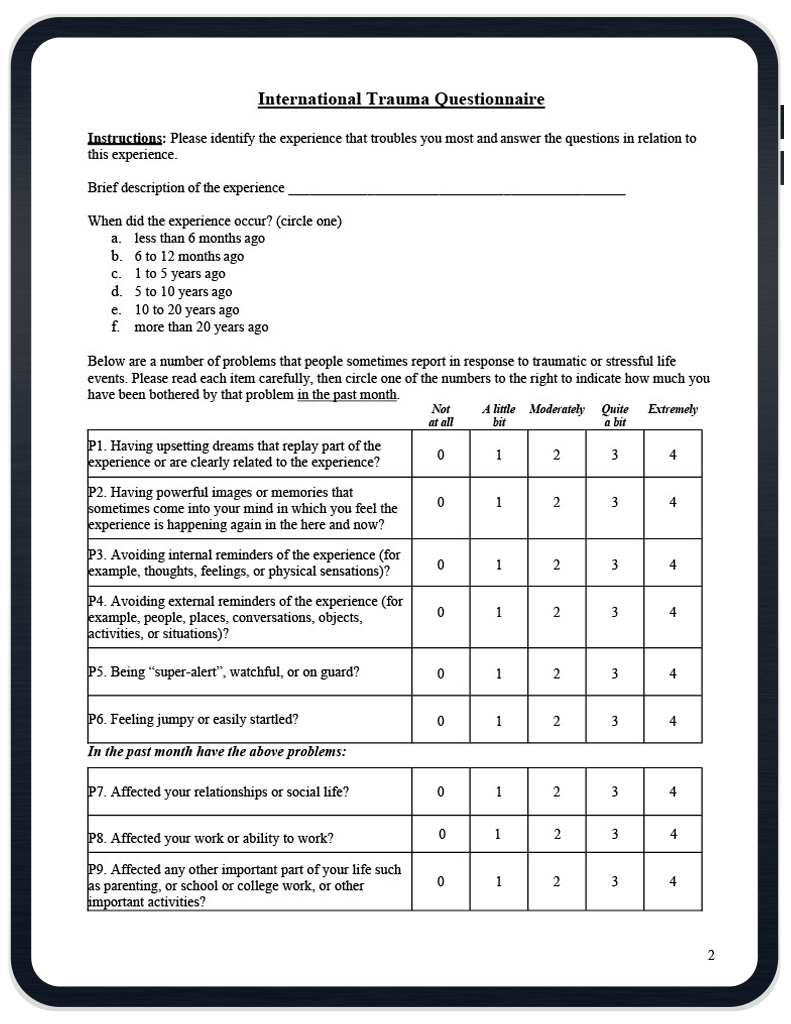
The International Trauma Questionnaire (ITQ) is a brief, simply worded measure, focusing only on the core features of PTSD and CPTSD, and employs straightforward diagnostic rules. The ITQ was developed to be consistent with the organizing principles of the ICD-11, as set forth by the World Health Organization, which are to maximize clinical utility and ensure international applicability through a focus on the core symptoms of a given disorder. The ITQ is freely available in the public domain to all interested parties.
This International Trauma Questionnaire Child and Adolescent Version (ITQ-CA) is a brief, simply-worded measure of Posttraumatic Stress Disorder and Complex Posttraumatic Stress Disorder symptoms for use with people aged 7 to 17 years. As with the International Trauma Questionnaire, the ITQ-CA was developed to be consistent with the organizing principles of the ICD-11, as set forth by the World Health Organization, which are to maximize clinical utility and ensure international applicability through a focus on the core symptoms of a given disorder. The ITQ-CA is freely available in the public domain to all interested parties.
The International Trauma Questionnaire (ITQ) is the most widely used measure of ICD-11 PTSD and CPTSD. The ITQ is used for many purposes, including estimating prevalence rates of these disorders in the general population and clinical samples. We believe that adding simple clinical checks to the ITQ (called the International Trauma Questionnaire with Clinical Checks (ITQ-CC)) can achieve many of the benefits of structured interviews while maintaining all the benefits associated with self-report measures. The ITQ-CC is freely available in the public domain to all interested parties.
The International Grief Questionnaire (IGQ) is a quick and easy-to-use measure of ICD-11 PGD. The scale was developed to measure all diagnostic requirements for ICD-11 PGD. The IGQ includes a brief measure of lifetime bereavement, two items measuring the essential symptoms of longing for the deceased and preoccupation with the deceased, and three items measuring the associated distress symptoms. Additional items measure requirements related to functional impairment and exceeding cultural norms.
A new measure under development for ICD-11 Prolonged Grief Disorder. The International Prolonged Grief Questionnaire (IPGDS) seeks to operationalize the ICD-11 definition of PGD in a self-report questionnaire format. The ICD-11 PGD definition is structured to have two core symptoms (item 1, item 2) and examples of emotional pain (accessory items 3-12). Item 13 indicates functional impairment and item 14 indicates cultural norms. The core and accessory symptoms are represented questions from previous measures (i.e. the integration of items from the PG-13 (Prigerson et al. 2008) and the SCI-CG (Bui et al. 2015). A new question on culture norms of bereavement is also included. The threshold for clinical diagnosis of PGD is currently under investigation. The IPGDS is freely available in the public domain to all interested parties.
The International Adjustment Disorder Questionnaire (IADQ) is a brief, simply-worded measure, focusing only on the core features of Adjustment Disorder, and employs straightforward diagnostic rules. The IADQ was developed to be consistent with the organizing principles of the ICD-11, as set forth by the World Health Organization, which are to maximize clinical utility and ensure international applicability through a focus on the core symptoms of a given disorder.
The International Depression Questionnaire (IDQ) is a self-report measure of ICD-11 Single Episode Depressive Disorder (ICD-11 diagnostic code 6A70). It can be used to generate severity scores and to identify cases meeting diagnostic requirements. The severity scoring method involves summing the scores of the 9 IDQ items, producing a possible range of scores from 0 to 36. No cut-off scores are proposed as caseness is defined by applying the ICD-11 diagnostic algorithm.
The International Anxiety Questionnaire (IAQ) is a self-report measure of ICD-11 Generalised Anxiety Disorder (ICD-11 diagnostic code 6B00). It can be used to generate severity scores and to identify cases meeting diagnostic criteria. The severity scoring method involves summing the scores of the 8 IAQ items, producing a possible range of scores from 0 to 32. No cut-off scores are proposed as ‘caseness’ is defined by applying the ICD-11 diagnostic algorithm.
.png)
The ITC is an international group of researchers, clinicians and professionals who work in the area of mentalhealth from around the world. Many of the members of the ITC have translated and validated the measures.